
Welcome to Pyragogy
Why Pyragogy:
Section titled “Why Pyragogy:”Pyragogy is an emergent, exploratory framework.
It does not claim to be:
- a closed theory,
- a validated pedagogy,
- or a finished model.
Its current purpose is to provide a conceptual and operational scaffold for investigating how learning changes when AI becomes a cognitive participant within peer-based knowledge creation.
Claims on this page are propositional and heuristic, and should be read as a research direction rather than settled doctrine.
The problem Pyragogy responds to
Section titled “The problem Pyragogy responds to”Artificial intelligence is rapidly reshaping how people access, produce, and validate knowledge.
In many contexts, however, AI-mediated learning risks reinforcing two long-standing failure modes:
- passive consumption (answers without understanding),
- isolated cognition (learning detached from peer feedback and shared meaning-making).
Pyragogy starts from a simple premise:
If peer learning changes what humans can know together, then human–AI collaboration changes what a learning ecology must be designed to withstand.
Building on the lineage of Peeragogy, Pyragogy extends peer-based learning into contexts where AI systems can:
- accelerate ideation and synthesis,
- simulate alternative perspectives,
- but also amplify epistemic risks (overconfidence, automation bias, false coherence).
Conceptual commitments (v0.x)
Section titled “Conceptual commitments (v0.x)”Pyragogy currently commits to five working assumptions:
- Knowledge is co-constructed, not transmitted.
- AI can be treated as a cognitive participant (without pretending it is human, autonomous, or inherently trustworthy).
- The quality of learning depends on process integrity (reciprocity, critique, reflection), not only outcomes.
- Friction is productive: disagreement and critique are essential for epistemic selection.
- Operational systems must remain human-in-the-loop and inspectable (ethically and methodologically).
These commitments are intentionally minimal: they are meant to be testable, revisable, and criticizable.
How Pyragogy relates to existing paradigms
Section titled “How Pyragogy relates to existing paradigms”Pyragogy does not replace earlier paradigms. It reframes the question of agency when AI enters the learning loop.
| Paradigm | Core focus | Role of AI | Unit of learning |
|---|---|---|---|
| Pedagogy | Instruction | Tool | Individual |
| Andragogy | Self-directed adult learner | Tool | Individual |
| Heutagogy | Self-determined learner | Tool | Individual |
| Peeragogy | Peer co-learning | Infrastructure | Group |
| Pyragogy | Human–AI co-creation | Cognitive participant | Human–AI collective |
The evolution of learning paradigms
Section titled “The evolution of learning paradigms”-
Pedagogy – Teacher-Directed Learning
Knowledge flows primarily from teacher to learner.
Reference: https://en.wikipedia.org/wiki/Pedagogy -
Andragogy – Adult Learning Principles
Adults learn through experience, relevance, and problem-solving.
Reference: https://en.wikipedia.org/wiki/Andragogy -
Heutagogy – Self-Determined Learning
Learners define goals, paths, and methods; focus on capability and learning how to learn.
Reference: https://en.wikipedia.org/wiki/Heutagogy -
Peeragogy – Collaborative Co-Learning
Learning with and from peers; shared goals, shared responsibility.
Reference: https://peeragogy.org/ -
Pyragogy – Human–AI Cognitive Symbiosis
An emergent frontier where humans and AI collaborate in iterative, inspectable learning loops.
Etymology and origin (minimal, non-mythic)
Section titled “Etymology and origin (minimal, non-mythic)”The term Pyragogy is intentionally crafted:
- pyra (πῦρ / πυρά) — fire as transformation (insight, friction, emergence)
- agōgia (ἀγωγία) — guiding / leading-through (process over prescription)
Conceptually, Pyragogy can be read as guiding through cognitive fire: a learning process shaped by interaction, critique, and iterative refinement.
The symbol π is used to evoke:
- recursive loops (learning as iteration, not linear progression),
- approximation (never fully “closed”),
- co-evolution (mutual adaptation over time).
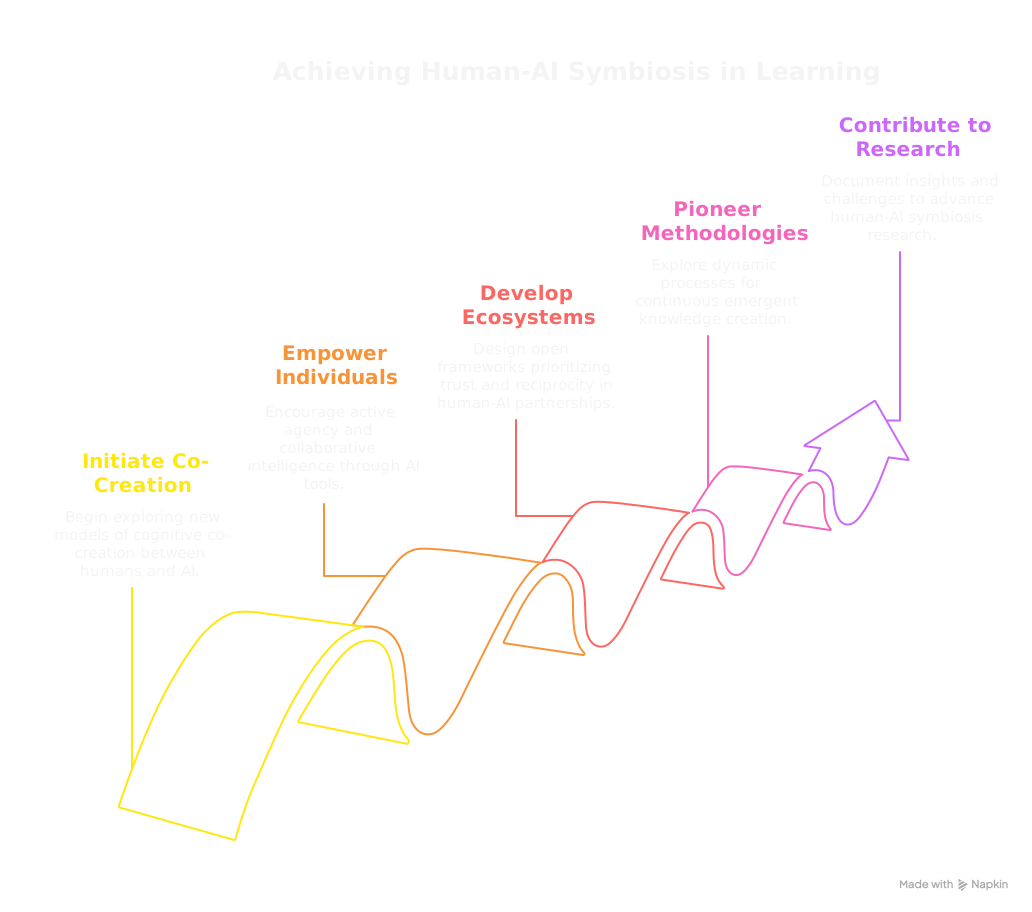
What Pyragogy aims to do next
Section titled “What Pyragogy aims to do next”Pyragogy is a living initiative with practical and research-oriented goals:
- Design learning environments where human peers and AI systems can collaborate without collapsing human agency.
- Document patterns, failures, and safeguards in human–AI co-learning loops (not only success stories).
- Develop early metrics and protocols for process integrity (reciprocity, critique, transparency).
- Invite independent critique and external research to test where Pyragogy works—and where it does not.
If you want to contribute, start from the documentation, experiments, and open questions across the project.