
The Pyragogy Syllabus
The Pyragogy Syllabus is the first applied research instrument built from the Pyragogy framework.
It is not a conventional syllabus in the academic sense. It is not a course sequence, a training program, or a validated curriculum. It is a living map: a structured environment for examining how humans learn with AI without surrendering attention, judgment, friction, responsibility, or autonomy.
Pyragogy provides the theoretical orientation. The Syllabus turns that orientation into something that can be inspected, navigated, tested, criticized, and revised.
Why the Syllabus exists
Section titled “Why the Syllabus exists”A theoretical framework remains incomplete if it cannot be observed in practice.
Pyragogy asks how artificial systems can participate in learning without quietly replacing the learner’s own cognitive work. This question cannot remain only abstract. It needs a space where concepts, risks, protocols, and developmental stages can be made visible.
The Syllabus exists for that reason.
It gives Pyragogy an applied layer. It allows the framework to move from conceptual argument to operational inquiry: from asking whether AI changes learning, to examining where, how, and under what conditions that change becomes productive or dangerous.
The central concern is not whether AI can make learning faster. It is whether AI-mediated learning can remain humanly accountable.
What the map contains
Section titled “What the map contains”The Syllabus organizes Pyragogy into a navigable set of nodes. Each node is designed to clarify a specific tension in human-AI learning.
The map includes several kinds of material:
- Conceptual anchors such as cognitive friction, autonomy, praxis, epistemic dependency, and automation bias.
- Developmental stages that describe how a learner’s relationship with AI may evolve from dependence toward critical autonomy.
- Risk patterns that identify where AI use can weaken attention, judgment, agency, or understanding.
- Protocols and practices for using AI as a partner in inquiry rather than as a substitute for thought.
- Autonomy markers that help distinguish assisted performance from genuine understanding.
- Observable signals that make the learning process easier to inspect, discuss, and refine.
The purpose is not to produce a fixed taxonomy. The purpose is to make the hidden structure of AI-mediated learning easier to see.
A map, not a course
Section titled “A map, not a course”The word “Syllabus” can be misleading if read too narrowly.
This project is not organized as a linear path from lesson one to lesson ten. It has no single correct entry point and no final certificate of completion.
It should be read as a map.
A reader may enter through a risk, such as epistemic dependency. Another may enter through a practice, such as using AI as a sparring partner. A teacher may enter through developmental stages. A researcher may enter through protocols and observable markers. A builder may enter through the design problem of creating tools that preserve friction instead of removing it.
This non-linear structure matters because Pyragogy is not trying to automate instruction. It is trying to preserve the conditions under which learning remains active.
The role of AI in the Syllabus
Section titled “The role of AI in the Syllabus”The Syllabus does not frame AI as an oracle.
It also does not frame AI as a harmless assistant whose task is only to simplify, summarize, and accelerate. In Pyragogy, the role of AI is more demanding and more limited.
AI can act as a cognitive partner when it helps expose assumptions, challenge weak reasoning, generate counterexamples, test claims, or force the learner to clarify what they actually think.
In this sense, AI is closer to a sparring partner than to a tutor. It does not replace the learner’s movement. It creates resistance against which the learner can become more precise.
When the machine becomes too helpful too early, the learner risks mistaking assistance for understanding.
How the Syllabus relates to Pyragogy
Section titled “How the Syllabus relates to Pyragogy”The Pyragogy documentation defines the broader orientation: why AI-mediated learning requires new concepts, why peer learning changes in the presence of artificial systems, and why autonomy cannot be treated as an automatic outcome of access to information.
The Syllabus takes those concerns and makes them operational.
It is where Pyragogy becomes readable as a working instrument. The concepts are no longer only described; they are placed into relation with risks, practices, stages, and observable markers.
In that sense, the Syllabus is not separate from Pyragogy. It is one of the ways Pyragogy tests itself.
If the documentation asks, “What kind of learning becomes possible when humans and AI systems think together?”, the Syllabus asks, “What would we need to observe in order to know whether that learning is actually happening?”
A provisional research instrument
Section titled “A provisional research instrument”The Syllabus is not presented as a settled methodology.
It remains provisional by design. Its nodes are open to revision, contradiction, extension, and refinement. This is not a weakness of the project. It is part of its research posture.
AI-mediated learning is still unstable. The tools change quickly. The habits around them change even faster. Any framework that claims finality too early risks becoming decorative rather than useful.
For this reason, the Syllabus should be treated as a working map: rigorous enough to guide inquiry, but open enough to be challenged by practice.
Explore the Syllabus
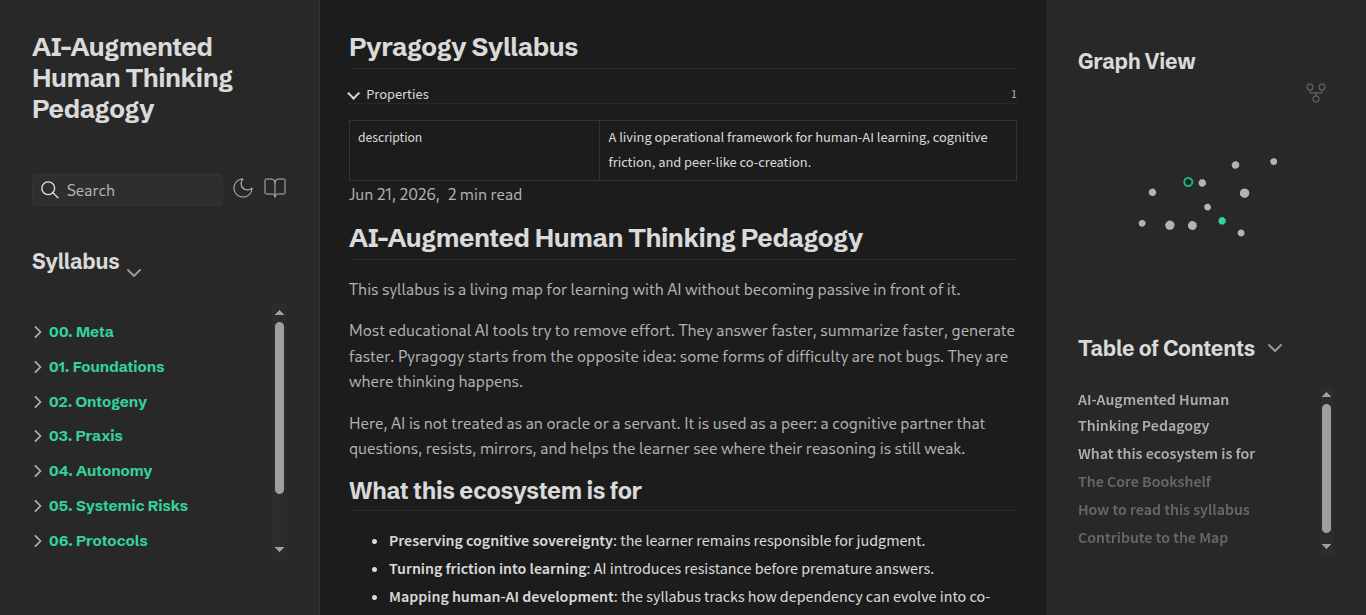
Section titled “Explore the Syllabus”The current map is available at syllabus.pyragogy.org.
It can be used as a reference, a research scaffold, a design aid, or a starting point for discussion. Its value does not lie in offering a finished answer. Its value lies in making the right tensions visible enough to work with.